
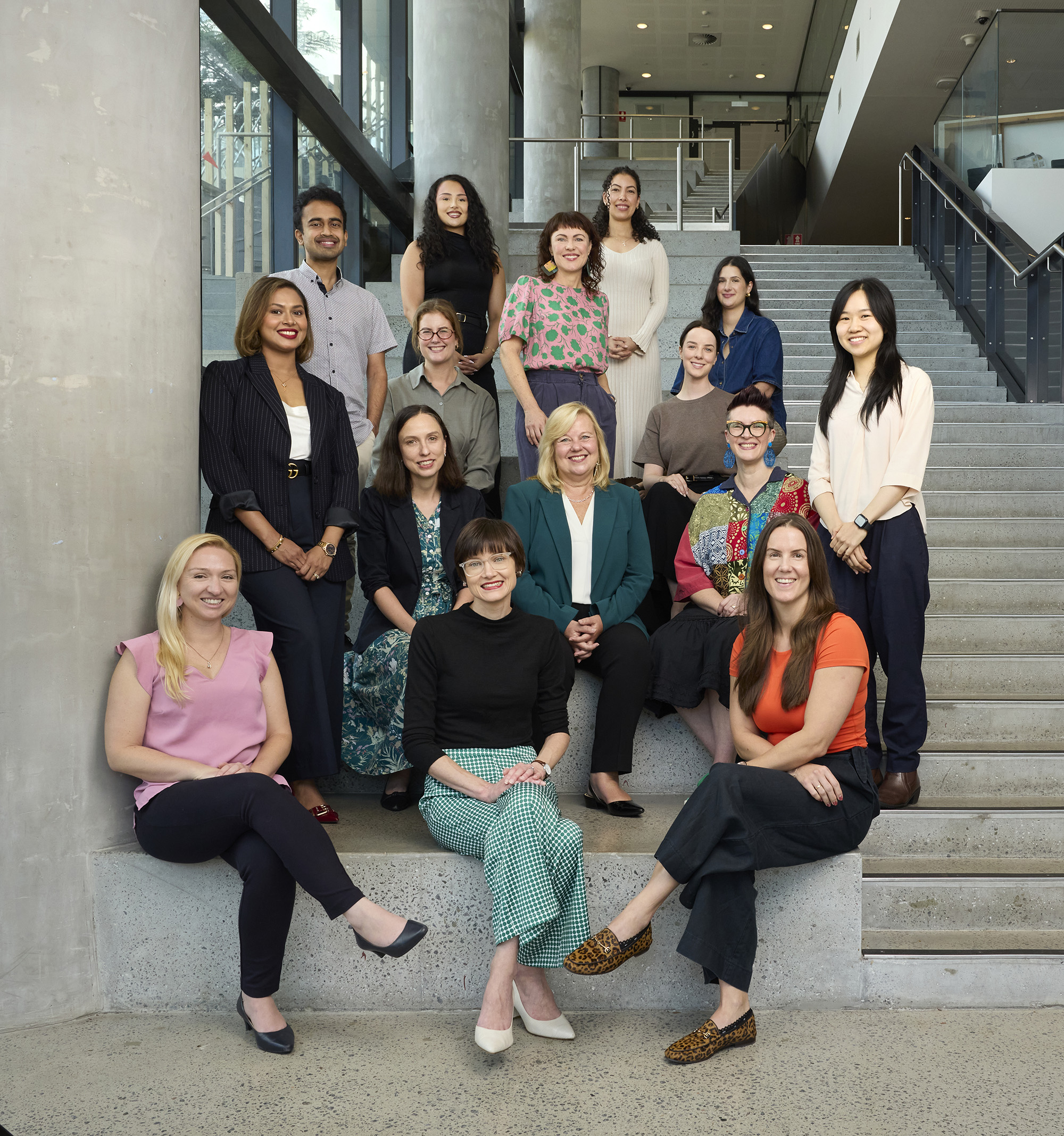
The University of Sydney Acquired Brain Injury Communication Lab is a team of researchers investigating communication disorders following acquired brain injury (ABI). We work with research participants with traumatic brain injury, aphasia following stroke, dementia and other acquired neurological communication disorders.
The team is lead by Professor Leanne Togher, and includes experienced researchers, early career researchers, PhD candidates and honours students.
Lab Team
- Professor Leanne Togher (Director)
- Dr Rachael Rietdijk
- Dr Melissa Brunner
- Dr Elise Bogart (formerly Elbourn)
- Dr Joanne Steel
- Dr Petra Avramovic
- Dr Sophie Brassel
- Dr Mona Faris
- Dr Emma Van Der Schyff
- Dr Megan Trebilcock
- Dr Chelsea Larkman
- Mrs Nazia Islam (Program Manager)
- Dr Olivia Maurice (Project Officer)
- Ms Kylie Southwell (Research Assistant)
- Mr Tushar Prasad (Research Assistant)
- Ms Charlene Lo (Research Assistant)
Honours Students
- Desiree Robinson
- Dora Xia
- Hayley Eskander
- Karen Li
- Kirrily Blyth
- Odette Cranwell-Schaeper
Higher Degree Research Students
- Kate Smith, PhD Candidate
- Kylie Southwell, PhD Candidate
- Naomi Folder, PhD Candidate
- Tushar Prasad, PhD Candidate
- Victoria Norris, PhD Candidate
- Naomi Hodder, Masters Candidate
Supporting Organisations
The American Congress of Rehabilitation Medicine (ACRM) unites rehabilitation professionals from around the world to advance evidence-based care, foster collaboration across disciplines, and translate cutting-edge research into clinical practice that improves lives every day.
The American Speech-Language-Hearing Association (ASHA) is the national professional, scientific, and credentialing association for 247,000 members, certificate holders, and affiliates who are audiologists; speech-language pathologists; speech, language, and hearing scientists; audiology and speech-language pathology assistants; and students.
The Australasian Society for the Study of Brain Impairment (ASSBI) is a multidisciplinary society dedicated to improving the quality of life of people with brain‐related conditions and their support networks
Brain Injury Australia (BIA) is the central clearinghouse of information and gateway to nationwide referral for optimising the social and economic participation of all Australians living with brain injury.
BIA was formed at the first national community-based conference on acquired brain injury (ABI) in 1986. The Federal Government began funding BIA in 1991.
The Centre for Research Excellence in Aphasia Rehabilitation and Recovery (Aphasia CRE) aims to transform the health and wellbeing of people with aphasia and their families through research that leads to enhanced, cost-effective and sustainable interdisciplinary aphasia rehabilitation and community services.
The Changineers are transforming the education sector by bridging technology, behavioural change and psychology with learning styles and teaching pedagogy to improve human connection and knowledge transfer.
The International Brain Injury Association (IBIA) is dedicated to the development and support of multidisciplinary medical and clinical professionals, advocates, policy makers, consumers and others who work to improve outcomes and opportunities for persons with brain injury.
We support speech and language therapists by providing leadership and guidance, facilitating research and promoting better education and training.
speechBITE is a database of intervention studies across the scope of speech pathology practice. Find out more about this evidence-based practice initiative on the pages below.
Speech Pathology Australia is the national peak body for the speech pathology profession in Australia representing more than 15,000 members. Speech pathologists are university educated allied health professionals with expertise in the assessment and treatment of communication and/or swallowing difficulties.
The goal of TalkBank is to foster fundamental research in the study of human communication with an emphasis on spoken communication. Currently, TalkBank provides repositories in 14 research areas, as represented by the links on this page. Rules for access to TalkBank data are described here.
The World Health Organization is a specialized agency of the United Nations which coordinates responses to international public health issues and emergencies. It is headquartered in Geneva, Switzerland, and has six regional offices and 150 field offices worldwide.
Individual Collaborators
Professor Emerita Robyn Tate has a background in clinical psychology and neuropsychology. Following 15 years of clinical practice primarily in the rehabilitation of traumatic brain injury, she pursued an academic career, where her research interests include evidence-based clinical practice, methodology of single-case designs, early recovery and long-term outcome after traumatic brain injury, and instrument development.
Alistair McEwan works on Gadigal country and is passionate about growing and strengthening capacity in cerebral palsy and neurodevelopmental disability research. Alistair is a non-Indigenous researcher committed to supporting Indigenous-led projects and partnering with people with lived experience in all our research
Among the many puzzles that language presents to the developmental psychologist, perhaps the most fascinating is the relative ease with which a toddler picks up a first language. Although infants know nothing of the rules of grammar and have only a fragmentary understanding of the physical and social world, they are able to master the core structures of language by the age of three. The ease with which children master their first language contrasts with the more painful and incomplete process of learning a second language in adulthood.
Bronwyn is a Certified Practicing Speech Pathologist, Fellow of Speech Pathology Australia, and Fellow of the International Society for Augmentative and Alternative Communication. With 15 years postdoctoral experience Bronwyn has been awarded more than $5M in research funding enabling development of a comprehensive program of research relating to communication, swallowing, social media, and other advanced assistive technologies (including VR/AR, generative AI, apps for communication, 3D food printing).
Professor Jennie Ponsford is the Director of the Monash-Epworth Rehabilitation Research Centre which was created in 2000. Its aim is to conduct research in trauma rehabilitation, with a view to reducing long-term disability. Over 30 psychologists and researchers are associated with the centre and form a dynamic research team. Affiliated Monash staff include A/Prof Rene Stolwyk, A/Prof Catherine Willmott, Dr Adam McKay, Dr Gershon Spitz, Dr Kate Gould, Prof John Olver, Dr Michael Ponsford, Dr Rose Acher, Dr Pamela Ross, Dr Marina Downing, Ms Meagan Carty, Ms Amelia Hicks, Mr Jai Carmichael, Dr Lucy Ymer, Dr Laura Connolly, Dr Jessica Trevena-Peters, Dr Toni Withiel, Dr David Lawson, Dr Courtney Spiteri, Ms Elinor Fraser, Ms Sarah Carrier, Dr Jonathan Reyes, Dr Jennifer Makovec Knight, Ms Jao Carmaniti, Dr Jade Murray, Mr Jack Nguyen, Ms Kiara Corso and A/Prof Gavin Williams.
Dr. Jerry Hoepner is a Professor at the University of Wisconsin – Eau Claire, Department of Communication Sciences and Disorders. He began teaching part-time for UWEC CSD in 2003 and full-time in 2007. He teaches courses in anatomy and physiology, undergraduate research, acquired cognitive disorders, dysphagia, and counseling. His research addresses healthcare perceptions, video self-modeling interventions for persons with acquired language or cognitive disorders, counseling methods and training, undergraduate research, non-course based learning, and instructional pedagogies.
Melinda Fitzgerald is the Deputy Vice Chancellor, Research at Curtin University, John Curtin Distinguished Professor and CEO of Connectivity Traumatic Brain Injury Australia. In her role as Deputy Vice Chancellor, Research, Prof Fitzgerald has responsibility for the portfolios of Research Partnerships, the Mining Technologies and Critical Minerals Trailblazer, the Curtin University National Resilience and Security Program Office, Research Services and Systems, and Research Excellence. She manages strategic initiatives to empower Curtin University to lead research that Australia and our global partners need now and for the future.
Department of Medicine
Health Condition Specialization: Communication Disorders, Movement Disorders, Multi-Morbidity, Non-Progressive Neurological Conditions
Professor Emerita of Communication Sciences and Disorders
Communication Sciences and Disorders, Crean College of Health and Behavioral Sciences
Expertise: Brain Injury; Cognitive Rehabilitation; Memory and Language; Metacognition
Professor Miranda Rose is a Principal Research Fellow and Director of the NHMRC funded Centre of Research Excellence in Aphasia Recovery and Rehabilitation (www.latrobe.edu.au/aphasiacre), a national centre based in the School of Allied Health, Human Services and Sport at La Trobe University.
PhD Epidemiology (Queen Mary, University of London), MSc Physiology (UCL), Grad Assoc Physiotherapy (Sheffield Hallam), GCert Ed Studies (Higher Ed). Sarah Dennis is Professor of Allied Health and Director of Movement Sciences, in the School of Health Sciences, Faculty of Medicine and Health. She is a leading primary care researcher with a focus on research that improves outcomes for people living with long-term conditions and translating these findings into clinical practice and policy. Her research aims to increase equitable access to high quality primary care, especially allied health, in the community to support people to maximise their well-being and reduce the burden on the Australian healthcare system.
I am a Professor of Clinical Neuropsychology at UNSW Australia. I have a BSc (Hons) from Monash University, a Masters degree in Clinical Neuropsychology from the University of Melbourne and a PhD from Macquarie University. I worked as a clinician with people with acquired brain disorders for 10 years before taking up my current academic post at UNSW.
Professor Steven Maguire is Deputy Dean (Research) at the University of Sydney Business School since January 2024, where he is leading implementation of the research enterprise component of the Business School’s 2023-27 strategy: engagement with industry, government, civil society, and academia to produce excellent research with clear, significant local and global impact.
Professor Sue McAllister is an expert speech pathologist, placement educator, project manager, resesarcher, and academic. Her research and education work is concerned with ensuring that the community can address its health and wellbeing goals through accessing a high quality disability and health workforce. Professor McAllister held the roles of Associate Dean Work Integrated Learning and then Deputy Dean Stratey in the former Faculty of Health Sciences and is currently Associate Dean Work Integrated Learning at the University of Canberra. She continues to hold an honorary role in the School and is a member of the Centre for Disability Research and Policy.
Professor Andrew J. Campbell is an internationally recognised authority in cyberpsychology, digital mental health, and the ethical application of emerging technologies to support human wellbeing. At The University of Sydney, he leads the Digital Health Group and is Chair and Head of the Cyberpsychology Research Group within the Sydney School of Public Health, Faculty of Medicine and Health.
Professor Emma Power is a speech pathologist and academic at the University of Technology Sydney. She has worked in the area of communication disability following acquired brain injury (ABI) for over 28 years in a variety of clinical and academic positions.
Assistant Professor, Comm Sci/Disorders
Dr Adeola Bamgboje-Ayodele is the Research Lead for the Discipline of Design, and a Lecturer in Design and Innovation at The University of Sydney’s School of Architecture, Design and Planning. Prior to this, she was a Research Fellow in Human Factors within the Faculty of Medicine and Health at the University of Sydney where she led a research stream on consumer-facing digital health tools and virtual care technologies. Adeola previously conducted postdoctoral research at the Ingham Institute of Applied Medical Research where she worked on designing and evaluating web portals for people living with and beyond cancer. Her research to date has focused on digital health intervention design, development, evaluation, and implementation to benefit clinicians, patients, caregivers, and health service organisations.
Anna is Senior Lecturer (Digital Health) in the Faculty of Medicine and Health, The University of Sydney. She has spent over a decade undertaking research in healthcare, with experience undertaking projects in diverse fields including health professions education, health services research, implementation science, and human-computer interaction. Anna is an affiliate in the Research in Implementation Science and eHealth Group.
Dr Anusha Withana is an Associate Professor in Human Computer Interaction (HCI) in the School of Computer Science, University of Sydney. His primary research focus is in developing devices that integrate a user’s body with the environment (blended interfaces). Prior to joining University of Sydney, he was a postdoctoral research fellow at the Saarland University and the Max Planck Institute for Informatics, Germany. He completed his PhD (2014) on the topic “Integration of multimodal interactions for Inter-Spatial Continuum” at Keio University, Japan under the supervision of Prof. Masahiko Inami. He has received a Masters in Media Design (2010) from Keio University and BSc (Hons.) in electronics engineering (2007) from University of Moratuwa, Sri Lanka.
Belinda supervises HDR students in topics related to acquired communication disorders, dysphagia and mealtime management , ethics and professional practice issues.
I am a cyberpsychologist specialising in social media and its intersection with health and wellbeing. My research investigates the digital experiences of vulnerable and stigmatised groups. I have conducted research with a range of groups, including people with dementia, carers, people with eating disorders, and LGBTQ+ individuals. My current research focuses on young-onset dementia and the role of social media in facilitating social connection, self-expression, and a sense of identity.
Assistant Clinical Professor, Rehabilitation Science
Associate Professor Cynthia Honan is an APHRA endorsed senior practising clinical neuropsychologist with specialist clinical training in neuropsychological assessment and cognitive rehabilitation. Cynthia’s areas of research focus largely on Moderate-to-Severe Traumatic Brain Injury and Multiple Sclerosis and the cognitive and psychological changes that result from these disorders. She has a specific interest in social cognition, cognitive fatigue and cognitive biomarkers, meta-social-cognitive functioning, and functional outcomes (e.g., employment and meaningful occupation). Cynthia recently led a large national project to develop clinical practice guidelines for the management of psychosocial difficulties (relating to mental health, behaviour, and social cognition) in moderate-to-severe traumatic brain injury, and is now part of a national team to implement these guidelines into clinical practice.
Dr Jarryd Daymond is Senior Lecturer in Strategy, Innovation, and Entrepreneurship and the Academic Director (Strategic Initiatives) at The University of Sydney Business School. He also holds a Fellowship with the Higher Education Academy, serves as a convenor for the Innovation and Commercialisation node of the Sydney Policy Lab, and previously held a Strategy Research Foundation Dissertation Scholarship from the Strategic Management Society.
Dr John Pierce is a speech pathologist and postdoctoral researcher at the Centre of Research Excellence in Aphasia Recovery and Rehabilitation, La Trobe University. His research focuses on improving outcomes for people with aphasia through innovation including rehabilitation technology and telehealth. John leads several funded programs of research, including the M-MAT Tele project—a novel, group-based telehealth intervention for aphasia—and a suite of initiatives exploring multilingual therapy access. He is also interested in the application of artificial intelligence to the field of aphasia.
Senior Research Fellow, Psychology
Turner Inst for Brain & Mental Health
Associate Professor
Graduate Program Coordinator
Communication Sciences & Disorders
Dr. Amon is a Senior Lecturer and Leadership Team member within the Cyberpsychology Research Group (CRG) in the Sydney School of Public Health at the University of Sydney. Her interests lie in developing and evaluating new programs using technology for mental health and in higher education. She has research experience in child and adolescent mental health and technology and has a strong interest in digital health and social media in research. Her research experience in these areas involved the use of biofeedback video games to assist children and adolescents with Attention-Deficit/Hyperactivity Disorder, training health students interviewing skills using simulation technology for health practice, and using Facebook for research recruitment. Her current research explores the use of social media platforms by healthcare professionals.
Current research involves exploration of discourse analysis in Speech Pathology across a range of communication disorders, the effects of language on ageing using methods drawn from clinical linguistics including computerised linguistic analysis methods. Liz has a special interest in clinical linguistics, discourse analysis and sociolinguistics with expertise in Systemic Functional Linguistic analysis. She has experience in supervising Research Higher Degrees and Honours projects.
Dr. Keegan’s primary research focuses on identifying the linguistic skills of individuals with cognitive communication disorders after traumatic brain injury. She employs various linguistic analysis methods to investigate the communication strengths and skills of this population. As a licensed Speech-Language Pathologist, she provides Speech-Language Pathology services to individuals with traumatic brain injury and thus, her research also examines optimal treatment approaches for these cognitive communication difficulties. In addition to clinical research, Dr. Keegan also conducts research in the scholarship of teaching and learning as related to the areas of clinical education, experiential learning and problem-based learning. She has numerous peer-reviewed publications, has received funding from the American Speech-Language-Hearing Association, and has presented her work at many national and international conferences.
Associate Professor Keep leads research into the ways in which we can better support people to live with early pregnancy loss. Her work into the workplace support following miscarriage in Australia formed part of the rationale for legislative change to provide women and their partners with paid bereavement leave following their loss. She is currently leading projects in physical activity following loss, and the role of culture in shaping experiences of support following loss. Mel is a founding member of the Early Pregnancy Loss Coalition which advocates for improved care, support, data and research into early pregnancy loss.
Dr Melanie Moses is a certified practising speech pathologist with 23 years of experience delivering rehabilitation services to people with communication and swallowing difficulties associated with traumatic and other types of acquired brain injury. Melanie received her doctorate in Speech Pathology at the University of Sydney in 2003 and has published internationally. Her strong academic focus, combined with a passionate interest in practical interventions, enables her to offer valuable skills in the area of acquired communication disorders. Melanie is committed to ongoing professional development and is a member of Speech Pathology Australia and the Australian Society for the Study of Brain Impairment (ASSBI) as well as a number of special interest groups.
Nicholas graduated from The University of Sydney, Australia in 1999 with a BAppSc in Speech Pathology. He worked as a Speech and Language Therapist in Australia before moving to the UK in 2003. His clinical roles have involved working with people with neurological conditions particularly, brain injury. Some of his clinical roles included the Royal Hospital of Neuro-Disability, Brain Injury Rehabilitation Trust and Defence Medical Rehabilitation Centre Headley Court.
Clinical Senior Lecturer
Faculty of Medicine and Health
I am a research leader who believes the best science is built with the people it is designed to serve. As a two-time NHMRC Emerging Leadership Fellow and Certified Practising Speech Pathologist, I lead a transdisciplinary team of more than 20 researchers at the University of Queensland. We work in partnership with consumers, clinicians, communities, government, and industry to co-produce interventions, technologies, systems, and standards that drive real change and serve the public good.
Jason is a compassionate clinician focused on helping clients regain independence and reconnect with daily life following serious injury or illness. He values collaboration with families, support workers, and professionals to achieve meaningful outcomes.
Nick Rushworth has been Executive Officer of Brain Injury Australia since 2008. He was also President of the Brain Injury Association of New South Wales between 2004 and 2008. In 1996, Nick sustained a severe traumatic brain injury as a result of a bicycle accident. Before joining Brain Injury Australia, Nick worked for the Northern Territory Government setting up their new Office of Disability. Formerly a producer with the Nine Television Network’s “Sunday” program and ABC Radio National, Nick’s journalism has won a number of awards, including a Silver World Medal at the 2003 New York Festival, a National Press Club and TV Week Logie Award.
I am a registered Clinical psychologist, Medicare approved, based in Sydney with over 25 years experience in Clinical Psychology services to adults ( 16 – 65) following complex and catastrophic injuries, particularly acquired brain injury. I am a registered Clinical psychologist, Medicare approved, based in Sydney with over 15 years experience in Clinical Psychology services to adults ( 16 – 65) following complex and catastrophic injuries, particularly acquired brain injury.
Penny Welch-West has been working as a Speech-Language Pathologist since 1998 and enjoys a very varied practice ranging from Rehabilitation through Complex/Continuing and Palliative Care. This work includes teaching, assessment and treatment in the areas of dysphagia (swallowing), voice, articulation, language, cognitive-communication and Augmentative and Alternative Communication (AAC).