
Get involved
There are many ways you can support our research.
- People with brain injury: Join our ABI Research Registry. or express your interest in the Social Brain Clinic
- Family members and friends, students or health professionals: Join our ABI Research Registry or sign up for the interact-ABI-lity course.

Our current projects
The Social Brain Clinic
We’re working on a new way to support people with traumatic brain injury (TBI) in building their communication skills.
In this virtual clinic, people with TBI work with speech pathology students, guided by our experienced educators. Peer mentors (other people with a brain injury) are also part of the team. The clinic is online and open to English speaking adults in Australia living with TBI.
ABI Research Registry: Volunteer for our research
The Acquired Brain Injury (ABI) Research Registry is a contact list to support our research.
Are you a person with an ABI or a family member / carer?
Would you like to be invited to take part in our research? Sign up via the link below.
Work together to improve conversations after brain injury
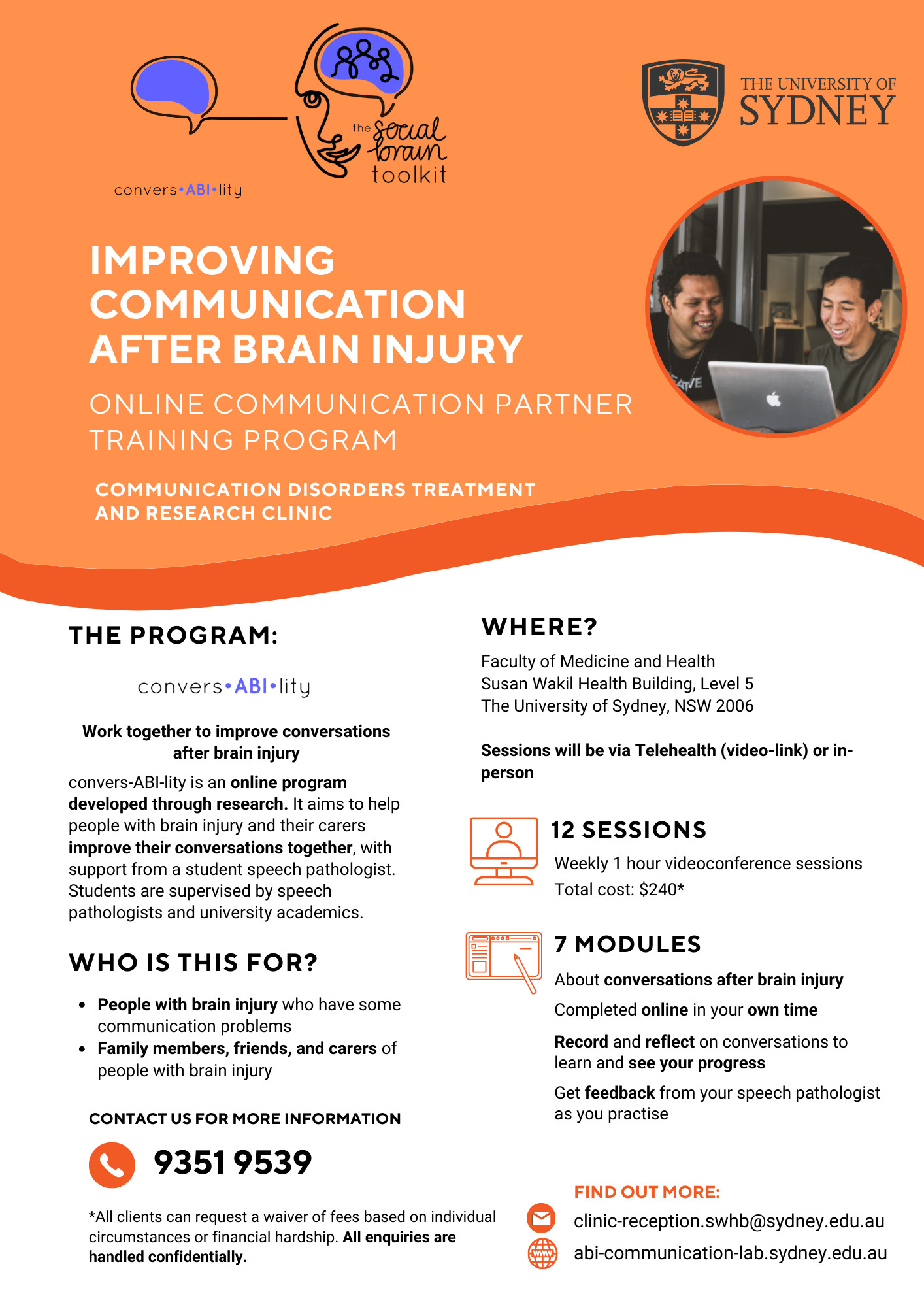
This online program is for people with brain injury and their carers to improve conversations together, with support from a speech pathologist.
- Progress through seven modules about conversations after brain injury
- Record and reflect on conversations to learn and see your progress
- Get feedback from your speech pathologist as you practise
- Connect to videocalls with your speech pathologist
convers-ABI-lity is running at the University of Sydney student speech pathology clinic. Read more here about the clinic. You can call (02) 9351 9539 or email to find out more.
Speech pathologists interested in using convers-ABI-lity in the future can complete this form.
Participate in training to improve social media skills after brain injury
We are looking for people who have an acquired brain injury who are interested in learning more about using social media after their injury.
We are asking people to:
If you would like to find out more about the course or the Facebook groups, please contact Dr Melissa Brunner on [email protected].
- complete an online social media training course (2 hours), and
- practice their social media skills in a closed Facebook group (for 8 weeks).
A tool to improve your interactions with people with a brain injury
interact-ABI-lity is a free short course designed for family members, friends, support workers, and professionals working in brain injury.
- Hear from people with a brain injury and their family members
- Learn about communication changes
- Learn how to support people with their communication
- Gain a certificate of completion
For more information, contact Dr Rachael Rietdijk on [email protected].